OpenDialKG: Explainable Conversational Reasoning with Attention-based Walks over Knowledge Graphs
We study a conversational reasoning model that strategically traverses through a largescale common fact knowledge graph (KG) to introduce engaging and contextually diverse entities and attributes. For this study, we collect a new Open-ended Dialog ↔KG parallel corpus called OpenDialKG, where each utterance from 15K human-to-human roleplaying dialogs is manually annotated with ground-truth reference to corresponding entities and paths from a large-scale KG with 1M+ facts. We then propose the DialKG Walker model that learns the symbolic transitions of dialog contexts as structured traversals over KG, and predicts natural entities to introduce given previous dialog contexts via a novel domain-agnostic, attention-based graph path decoder. Automatic and human evaluations show that our model can retrieve more natural and human-like responses than the state-ofthe-art baselines or rule-based models, in both in-domain and cross-domain tasks. The proposed model also generates a KG walk path for each entity retrieved, providing a natural way to explain conversational reasoning.
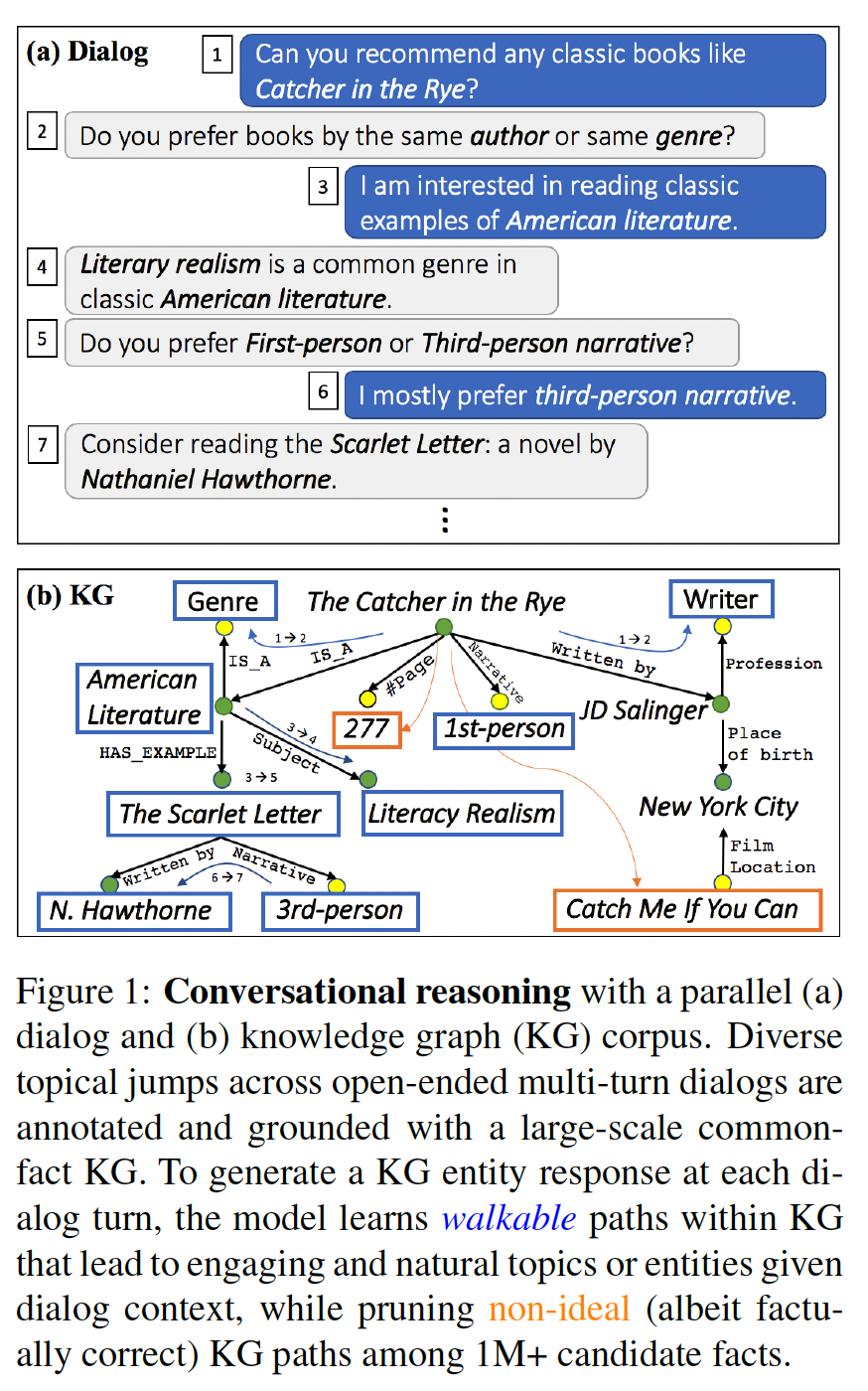
Introduction. The key element of an open-ended dialog system is its ability to understand conversational contexts and to respond naturally by introducing relevant entities and attributes, which often leads to increased engagement and coherent interactions (Chen et al., 2018). While a large-scale knowledge graph (KG) includes vast knowledge of all the related entities connected via one or more factual connections from conversational contexts, the core challenge is in the domain-agnostic and scalable prediction of a small subset from those reachable entities that follows natural conceptual threads that can keep conversations engaging and meaningful. Hence, we study a data-driven reasoning model that map dialog transitions with KG paths, aimed at identifying a subset of ideal entities to mention as a response to previous dialog contexts. Figure 1 illustrates a motivating dialog example between two conversation participants, which spans multiple related KG entities from a starting seed entity The Catcher in the Rye.
Discussion / Conclusion. We study conversational reasoning grounded on knowledge graphs, and formulate an approach in which the model learns to navigate a largescale, open-ended KG given conversational contexts. For this study, we collect a newly annotated Dialog ↔KG parallel corpus of 15K humanto-human dialogs which includes ground-truth annotation of each dialog turn to its reasoning reference in a large-scale common fact KG. Our proposed DialKG Walker model improves upon the state-of-the-art knowledge-augmented conversation models by 1) a novel attention-based graph decoder that penalizes decoding of unnatural paths which effectively prunes candidate entities and paths from a large search space (1.1M facts), 2) a zeroshot learning model that predicts its relevance score in the KG embeddings space, combined score of which is used for candidate ranking. The empirical results from in-domain, cross-domain, and transfer learning evaluation demonstrate the efficacy of the proposed model in domain-agnostic conversational reasoning.
Lines of inquiry this paper opens 24
Research framings built by reading the notes related to this paper — the questions it feeds into.
How do coordinated agents balance protocol compliance with reward maximization? What mechanisms preserve shared understanding in evolving conversations?- What dialogue dynamics distinguish negotiation from standard information-provision tasks?
- How should dialogue state tracking change when user preferences shift mid-conversation?
- Why do comprehensive posts without uncertainty tend to suppress conversation?
- Why does context collapse pose risks in high-stakes conversations?
- What moves become possible when you represent ASR as a noisy observation model?
- How do belief distributions help systems recover from speech recognition errors?
- Does the same uncertainty-driven logic appear in other conversation systems?
- Can AI ever lead conversations without the anticipatory presence sustained attention provides?
- Can dialogue systems abstain from responding when uncertainty is too high?
- Can language systems learn when to ask for clarification instead of choosing one reading?
- How do training-data priors influence model defaults when context is ambiguous?
- Can explicit numerical signals override learned linguistic defaults in fine-tuned models?
- How does the silent token approach compare to modeling intrinsic motivation for speaking?
- How do models signal knowledge gaps through token probability?