Learning To Retrieve Prompts for In-Context Learning
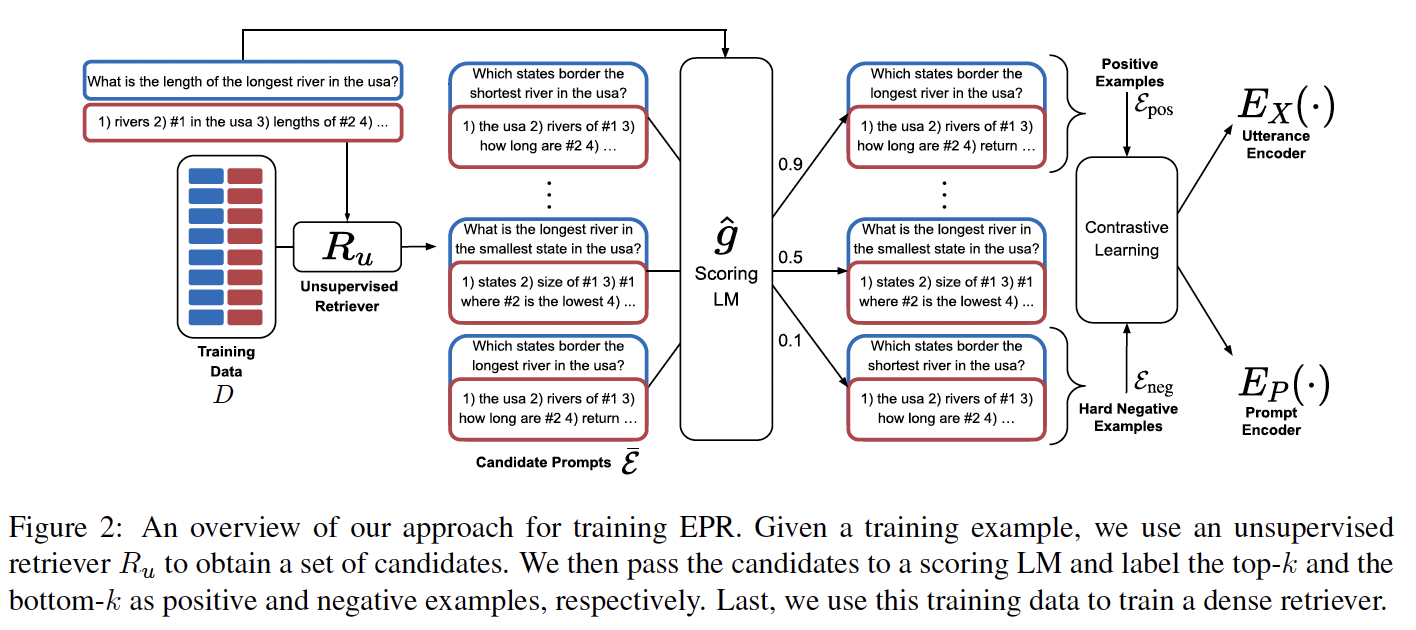
In-context learning is a recent paradigm in natural language understanding, where a large pre-trained language model (LM) observes a test instance and a few training examples as its input, and directly decodes the output without any update to its parameters. However, performance has been shown to strongly depend on the selected training examples (termed prompts). In this work, we propose an efficient method for retrieving prompts for incontext learning using annotated data and an LM. Given an input-output pair, we estimate the probability of the output given the input and a candidate training example as the prompt, and label training examples as positive or negative based on this probability. We then train an efficient dense retriever from this data, which is used to retrieve training examples as prompts at test time. We evaluate our approach on three sequence-to-sequence tasks where language utterances are mapped to meaning representations, and find that it substantially outperforms prior work and multiple baselines across the board.
Introduction. The striking language skills and world knowledge embedded in large pre-trained language models (LMs) (Devlin et al., 2019; Petroni et al., 2019; Raffel et al., 2020; Brown et al., 2020) have recently led to in-context learning, a new paradigm in natural language understanding. Under this paradigm, a language model is given a prompt, which typically contains a few training examples, as well as a test instance as input, and generates the output for the test instance directly, without any update to its parameters. This approach was first introduced in GPT-3 (Brown et al., 2020), but has quickly spread to other LMs (Lieber et al., 2021; Du et al., 2021; Rae et al., 2021). An attractive property of in-context learning is that it provides a single model for multiple language understanding tasks. However, Liu et al. (2021a) showed that downstream performance can vary widely depending on the choice of in-context examples. This has sparked interest in prompt retrieval (see Fig. 1), where given a test instance, training examples are chosen for the prompt based on some similarity metric.
Discussion / Conclusion. Large pre-trained LMs are becoming an inseparable part of the natural language understanding ecosystem. However, accessing their weights or updating them can be prohibitive for many researchers. In this work, we propose EPR, a method for learning to retrieve good prompts for in-context learning, by using language models themselves as the scoring function. This allows us to train a light-weight retriever and substantially improve performance on three challenging tasks. More broadly, given that large LMs models are likely to play a prominent role in developing language understanding models, it is important to develop approaches for interacting with such models effectively. EPR can be viewed as a step in this direction.