SteerLM: Attribute Conditioned SFT as an (User-Steerable) Alternative to RLHF
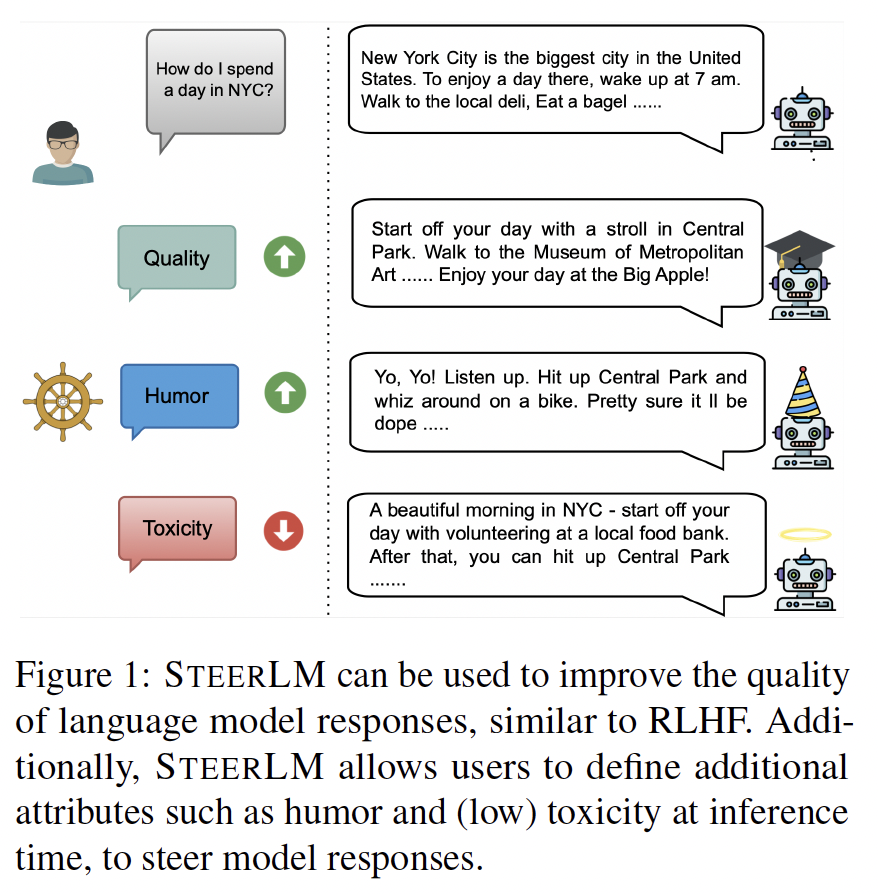
Model alignment with human preferences is an essential step in making Large Language Models (LLMs) helpful and consistent with human values. It typically consists of supervised fine-tuning (SFT) and reinforcement learning from human feedback (RLHF) stages. However, RLHF faces inherent limitations stemming from a complex training setup and its tendency to align the model with implicit values that end users cannot control at run-time. Moreover, reward models in RLHF stage commonly rely on single-dimensional feedback as opposed to explicit, multifaceted signals that indicate attributes such as helpfulness, humor, and toxicity. To address these limitations, we propose STEERLM, a supervised finetuning method that empowers end-users to control responses during inference. STEERLM conditions responses to conform to an explicitly defined multi-dimensional set of attributes, thereby empowering a steerable AI capable of generating helpful and high-quality responses while maintaining customizability. Experiments show that STEERLM trained on open source datasets generates responses that are preferred by human and automatic evaluators to many state-of-the-art baselines trained with RLHF while being much easier to train. Try STEERLM at https://huggingface.co/ nvidia/SteerLM-llama2-13B
Introduction. Training LLMs on extensive text corpora has demonstrated remarkable capabilities, leading to state-of-the-art performance on numerous tasks (Brown et al., 2020; Kaplan et al., 2020). However, this does not automatically make language models effective in responding to user instructions (Wei et al., 2022; Sanh et al., 2022). To better align LLMs to human preferences, the most effective approach has been to perform SFT followed by the application of RLHF (Wang et al., 2023a; Chiang et al., 2023; Peng et al., 2023). In SFT, human annotators provide demonstrations of instructions and responses for the model to imitate (Taori et al., 2023; Zhang et al., 2023). RLHF goes a step further to enable models to generate responses that human annotators prefer to alternative responses (Bai et al., 2022; Ouyang et al., 2022; Köpf et al., 2023a). However, despite its success, there are limitations to this approach. First, using SFT alone does not allow the model to distinguish between highquality and low-quality responses leading to lower performance than RLHF (Wang et al., 2023a).
Discussion / Conclusion. We introduce STEERLM, a novel model alignment approach with a value system (e.g. humor level and toxicity tolerance) that can be adjusted by users at inference time without re-training. STEERLM trains both the attribute prediction model and the language model using only supervised fine-tuning, resulting in an easy-to-implement and straightforward training process compared to using RLHF. We train STEERLM models following this procedure, achieving state-of-the-art results on the Vicuna benchmark. We validate these results with a human evaluation and find that STEERLM is preferred over the other models we compare it to. We hope our work will inspire further research into developing simple and effective model alignment methods that empower better AI assistants for everyone.