Interpretation modeling: Social grounding of sentences by reasoning over their implicit moral judgments
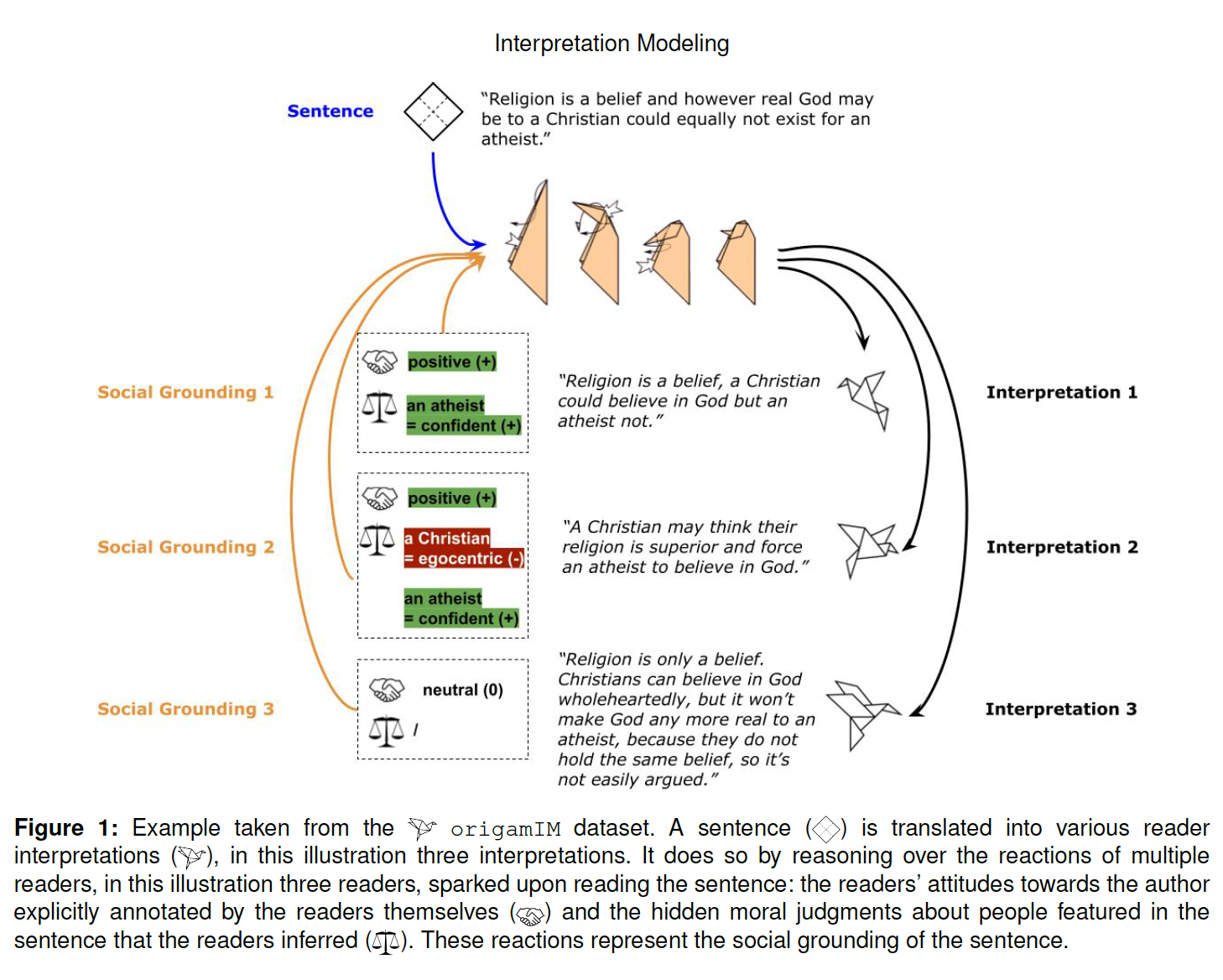
The social and implicit nature of human communication ramifies readers’ understandings of written sentences. Single gold-standard interpretations rarely exist, challenging conventional assumptions in natural language processing. This work introduces the interpretation modeling (IM) task which involves modeling several interpretations of a sentence’s underlying semantics to unearth layers of implicit meaning. To obtain these, IM is guided by multiple annotations of social relation and common ground - in this work approximated by reader attitudes towards the author and their understanding of moral judgments subtly embedded in the sentence. We propose a number of modeling strategies that rely on one-to-one and one-to-many generation methods that take inspiration from the philosophical study of interpretation. A first-of-its-kind IM dataset is curated to support experiments and analyses. The modeling results, coupled with scrutiny of the dataset, underline the challenges of IM as conflicting and complex interpretations are socially plausible. This interplay of diverse readings is affirmed by automated and human evaluations on the generated interpretations.
Introduction. When simulating human understanding of sentences in natural language, artificial intelligence systems need to look beyond the surface and reason about the communication that is happening between the lines, acknowledging that one unambiguous interpretation of a sentence’s meaning in natural language rarely exists. Among the root causes of diverse interpretations are properties of the sentence itself, such as lexical, structural, and pragmatic ambiguities (A. Liu et al., 2023). However, diversity is notably amplified by the unique perspectives of individual readers. Going beyond the conventional exploration of surface-level and contextual ambiguities in natural language understanding, this work examines ambiguities at the hidden level of a sentence and models multiple sentence interpretations by grounding sentences in society using various reader understandings of their implicit meanings. We propose the interpretation modeling (IM) task which posits that single ground-truth evaluations and interpretations ignore the complex social reality of natural language understanding.
Discussion / Conclusion. We started from the premises that natural language understanding (NLU) inevitable has to deal with content left implicit and that grounding language in its social context is a necessary condition to make implicit content explicit. We introduced the interpretation modeling (IM) task which aims at capturing the implicit and explicit meaning of a sentence as understood by different readers. IM is guided by multiple annotations of social relation and common ground - in this work approximated by reader attitudes towards the author and their understanding of moral judgments subtly embedded in the sentence. We proposed a number of strategies to decode a sentence into its multiple interpretations in the form of natural language text. The one-to-one and one-to-many interpretation generation methods that we have proposed are inspired by the philosophical study of interpretation. As a first of its kind, an IM dataset is curated to support experiments and analyses.