Openagents: An Open Platform For Language Agents In The Wild
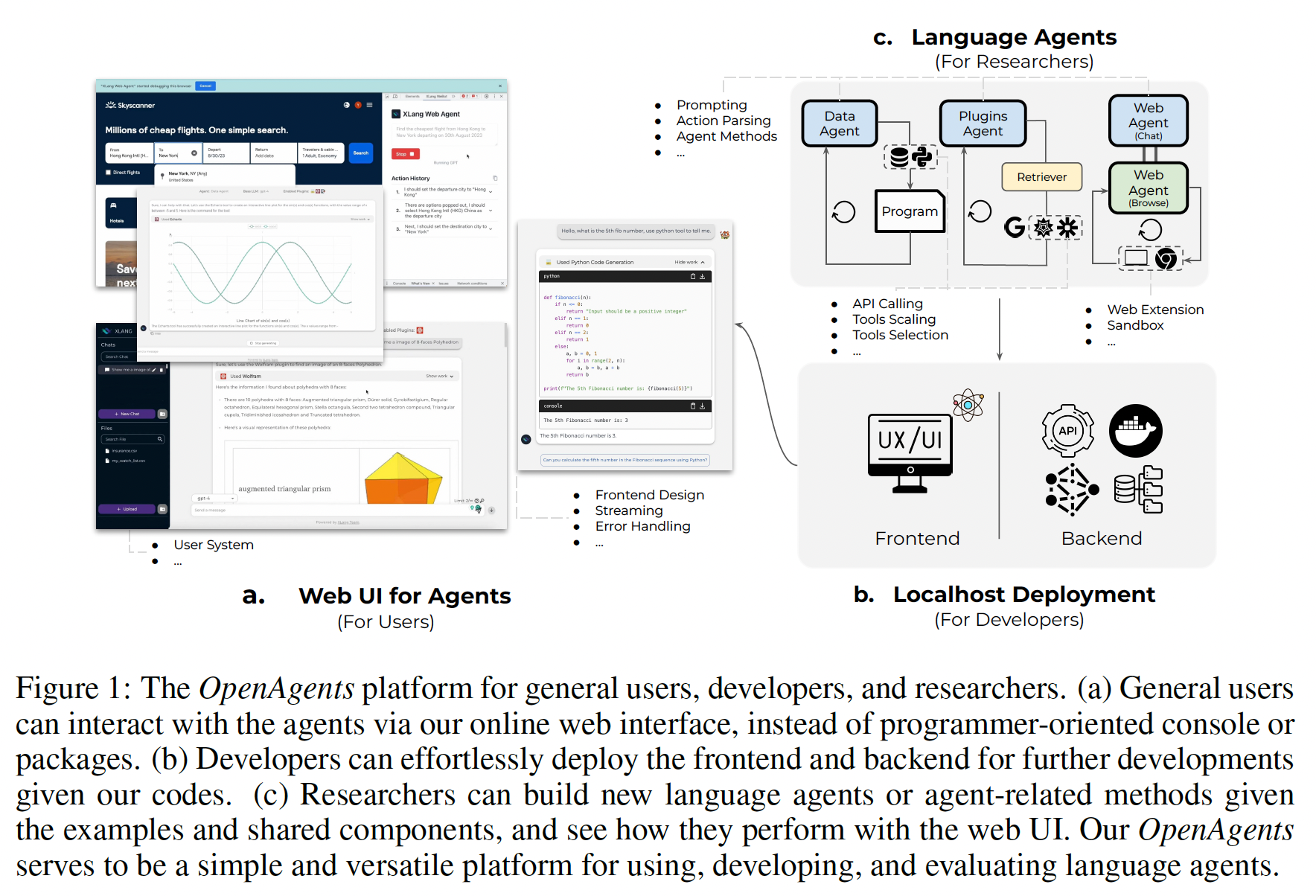
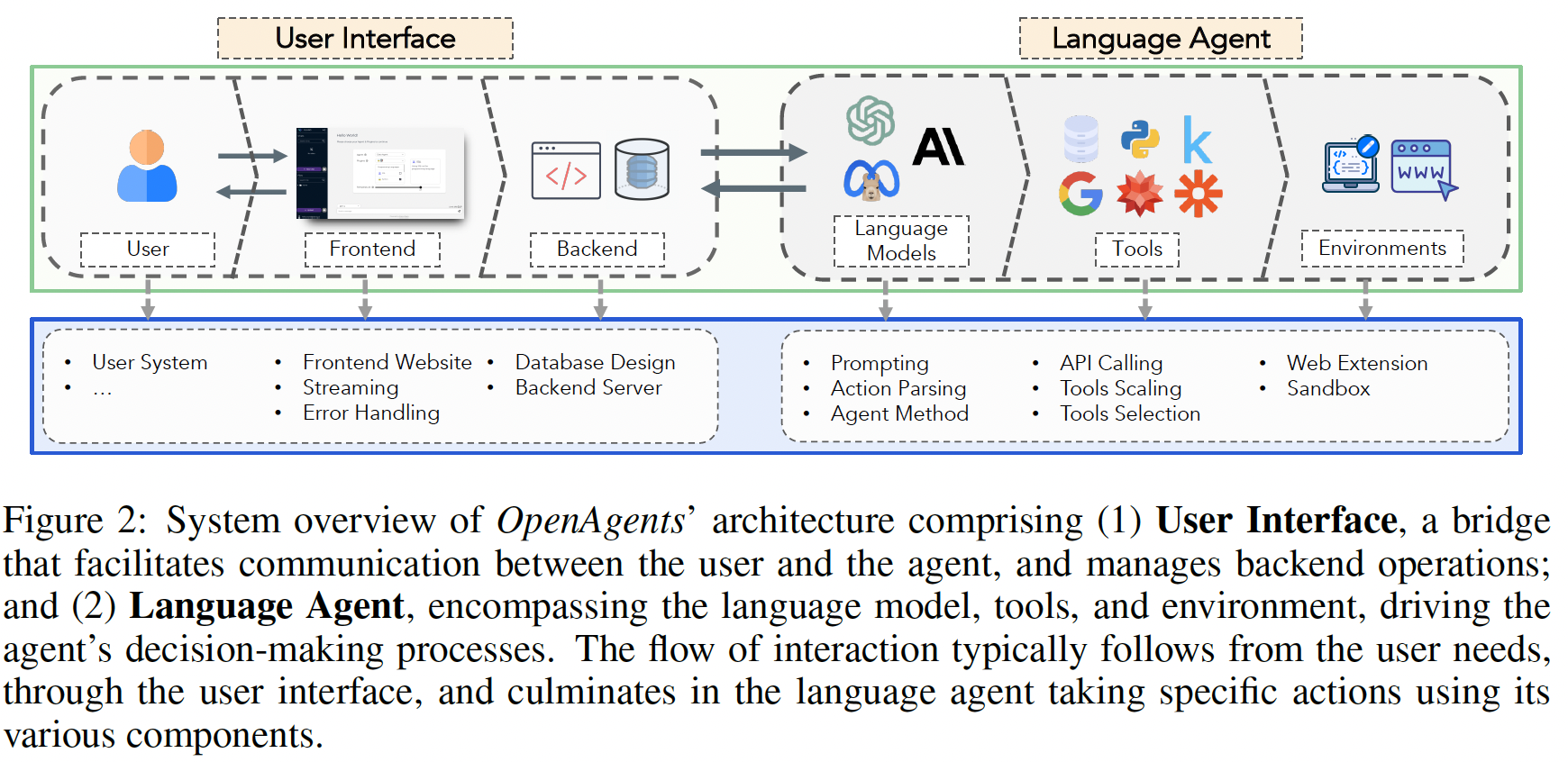
Language agents show potential in being capable of utilizing natural language for varied and intricate tasks in diverse environments, particularly when built upon large language models (LLMs). Current language agent frameworks aim to facilitate the construction of proof-of-concept language agents while neglecting the non-expert user access to agents and paying little attention to application-level designs. We present OpenAgents, an open platform for using and hosting language agents in the wild of everyday life. OpenAgents includes three agents: (1) Data Agent for data analysis with Python/SQL and data tools; (2) Plugins Agent with 200+ daily API tools; (3) Web Agent for autonomous web browsing. OpenAgents enables general users to interact with agent functionalities through a web user interface optimized for swift responses and common failures while offering developers and researchers a seamless deployment experience on local setups, providing a foundation for crafting innovative language agents and facilitating real-world evaluations. We elucidate the challenges and opportunities, aspiring to set a foundation for future research and development of real-world language agents.
Introduction. Intelligent agents are broadly conceptualized as autonomous problem solvers with the ability to sense their environment, decide, and act upon that environment (Wooldridge & Jennings, 1995; Sutton & Barto, 2005; Russell, 2010). With the advent of large language models (LLMs) (Brown et al., 2020; Chen et al., 2021; Chowdhery et al., 2022; OpenAI, 2023b; Touvron et al., 2023), recent implementations from the academic, industry, and open-source communities have leveraged this concept to create language agents. These agents are capable of utilizing natural language to perform a variety of intricate tasks in diverse environments, showcasing notable potentials (Yao et al., 2022b; Chase, 2022; Gravitas, 2023; OpenAI, 2023a; Wang et al., 2023a). Meanwhile, current agent frameworks such as Chase (2022), Gravitas (2023), Xu et al. (2023a), Nakajima (2023), Chen et al. (2023), Zhou et al. (2023c) provide proof-of-concept implementations and console interfaces largely tailored for developers.
Discussion / Conclusion. Agent Applications OpenAgents sets up a whole pipeline of building application-level language agents, thus paving the way for other innovative applications such as customizable dialogue systems, multimodal interaction, and automated workflow integrations for end-users. Each of these applications not only offers unique advantages but also collectively contributes to a richer and more user-centric agent application environment. Tool and Component Integration OpenAgents explores and addresses the fundamental requisites for constructing a practical-level agent application, laying down a robust foundation that allows the community to effortlessly expand horizontally by integrating additional components such as tools (e.g., integrate from more diverse API sources like PublicAPIs2), extending more foundation models (e.g., recent large multimodal models (i.a. Li et al., 2023a; Yang et al., 2023b)), adapting to new UIs designs, etc.